


The EUDR Regulation: A New Era for Supply Chains
EUDR 2026 – new obligations regarding import, export and transport
Key dates
30 December 2026
Large and medium-sized enterprises
30 June 2027
Micro and small enterprises
What is the EUDR?
The EUDR (European Union Deforestation Regulation) is a key component of the European Green Deal. Its aim is to minimise the European Union’s contribution to deforestation and forest degradation worldwide. The regulations require companies to prove that their products do not originate from areas deforested after 31 December 2020.
Key facts in 30 seconds
Purpose
Elimination of products linked to deforestation.
Raw materials
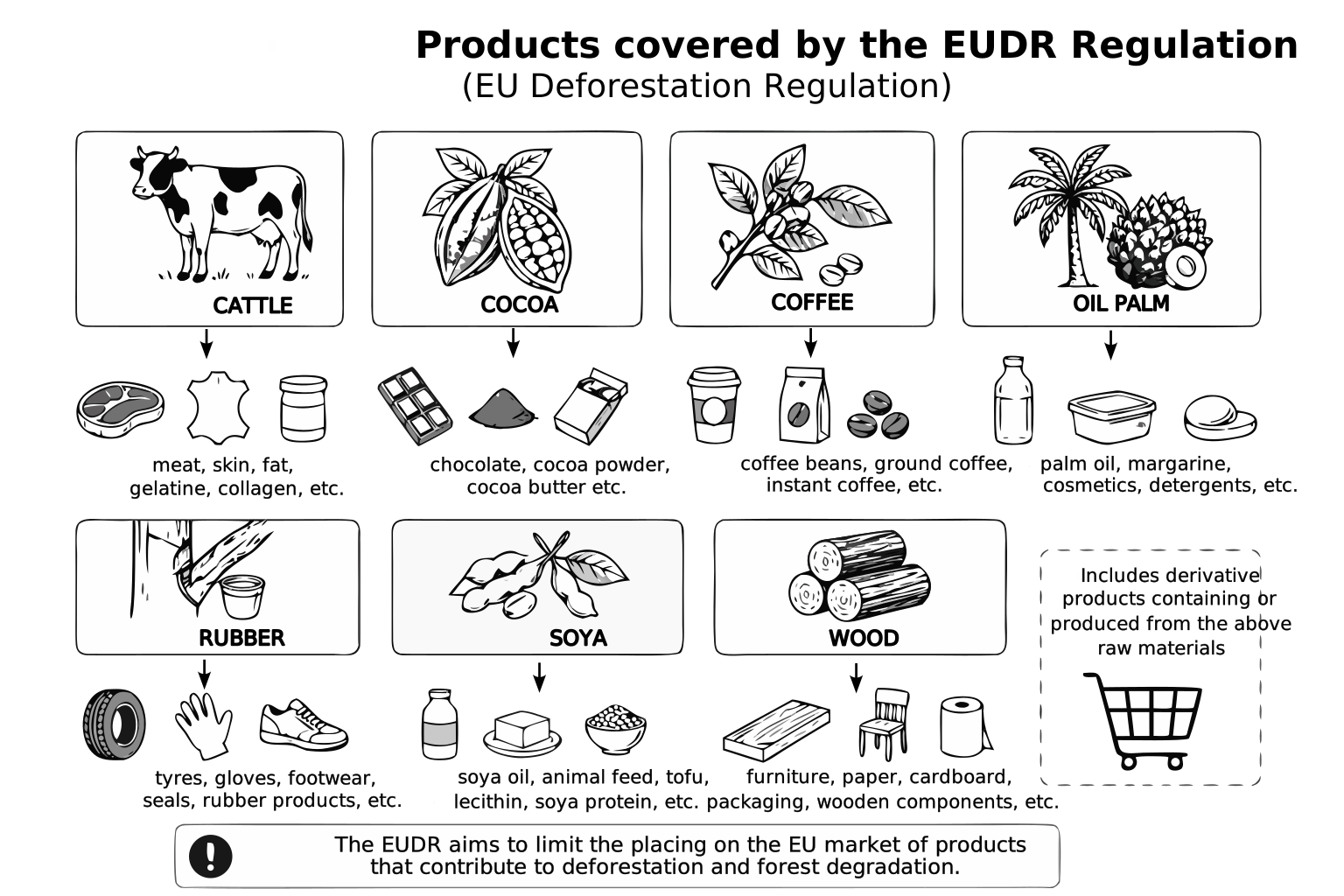
7 main groups and hundreds of related products.
TRACES
Mandatory DDS declaration prior to clearance.
Penalties
Up to 4% of annual turnover in the EU.
Products covered by the EUDR
Classification of countries by risk level (Benchmarking)
Low risk
Simplified due diligence procedure.
- There is no obligation to carry out a detailed risk assessment.
- No obligation to implement mitigation measures.
- Approximately 1% of entities are audited each year.
Standard risk
A full due diligence process.
- Mandatory risk assessment.
- Restrictive measures, if necessary.
- Audits of approximately 3% of entities.
High risk
The highest level of verification.
- In-depth supplier analysis.
- There is a high likelihood of an inspection.
- Audits covering as many as 9% of entities and turnover.
What remains mandatory?
- Geolocation of plots: GPS coordinates or polygons.
- Proof of legality: evidence of compliance with the laws of the country of production.
- DDS declaration: registration of each consignment in the TRACES system.
- DDS reference number: required prior to customs clearance.
No special treatment
The ‘Low Risk’ status simplifies the procedure, but does not exempt you from the obligation to collect data and submit a DDS declaration.
POL-AGENT tip
It is essential for importers to keep a close eye on the European Commission’s ranking list. Imports from high-risk countries significantly increase the likelihood of inspections and require the implementation of robust supplier verification procedures.
How can you prepare your company for the EUDR?
- Identify the goods covered by the regulation.
- Verify the origin of the raw materials and their geographical location.
- Assess the risk of deforestation.
- Submit your DDS declaration via the TRACES system.
- Please pass on the DDS number to the customs agency and the logistics department.
The importer is responsible for due diligence and for submitting the DDS declaration.
Exporters must hold documentation confirming the conformity of the goods.
Carriers and freight forwarders should obtain a DDS number prior to customs clearance.
Fines, confiscation of goods and a ban on trading within the EU.
EUDR checklist – what needs to be done right now?
Key simplifications in the EUDR Regulation (Updated: April 2026)
| Category | Type of simplification / Change | Benefit for the business |
|---|---|---|
| Further links in the chain | The ‘DDS Reference’ principle | Distributors and exporters do not need to carry out a new risk assessment; it is sufficient to provide the DDS number of the previous supplier in the EU. |
| Small plots | GPS point (< 0,5 ha) | For plots smaller than 0.5 ha, a single set of coordinates is sufficient instead of drawing the entire polygon. |
| Recycling | Exemption for 100% recycled content | Products made entirely from recycled materials (paper, rubber, retreaded tyres) are exempt from the EUDR. |
| Tyres | Retreading | Retreaded tyres (CN 4012) are classified as recovered goods and do not require a DDS declaration or geolocation. |
| Automotive | Fitted components | Tyres and leather parts fitted to finished vehicles are not subject to the EUDR (the vehicle’s CN code determines this, e.g. 8703). |
| Benchmarking | ‘Low Risk’ countries | Exemption from stages 2 and 3 (risk analysis and mitigation). Only stage 1 (basic data and GPS) is required. |
| Supply chain | “Mass Balance” certification | The rules governing the blending of raw materials (e.g. rubber) have been clarified, making it easier to assign plot groups to production batches. |
| Digitisation | System interoperability | The ability to automatically import data from official national forest registers into the TRACES NT system. |
| Stocks | Transitional period | Flexibility for goods manufactured before the regulations come into force (29 June 2023) and clear rules on the disposal of stock placed on the market before December 2026. |
Do you need assistance with the EUDR?
POL-AGENT supports importers, exporters and transport companies in preparing documentation and handling customs clearance in accordance with the EUDR.