


Świnoujście, Gdynia, or Gdańsk? Choosing a cargo ferry route
For a freight forwarder planning transport to Scandinavia, choosing the departure port is more than just a matter of kilometers on a map. It involves calculating driver working hours, fuel costs, road tolls, and space availability on board. In this article, we compare the most popular Polish cargo ports to help you make the most profitable decision.
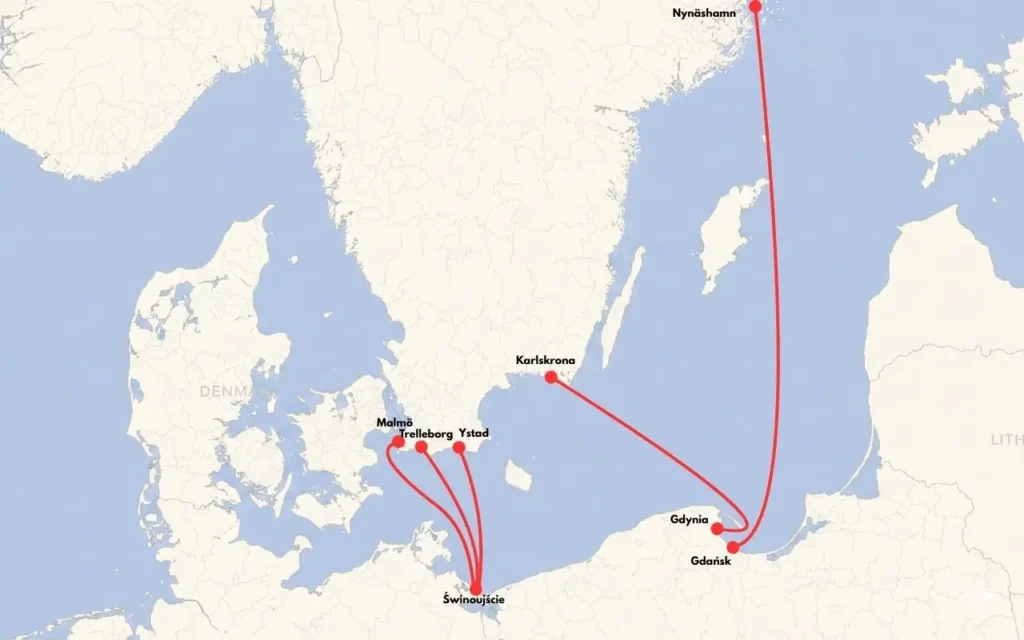
Map of ferry connections between Poland and Sweden
Why does the departure port matter?
Ferry crossing cost calculation must take into account not only the ticket price, but also:
- ✔
Driver working hours (tachograph) - ✔
Fuel consumption for travel to the terminal - ✔
Road tolls (ViaToll / e-TOLL) - ✔
ETS (Environmental Tax) – new regulations affecting costs
Logistics in Practice: Swinoujscie or Tricity?
Western Corridor: Świnoujście as a Frequency Leader
For transports originating from western and southern Poland, as well as from Germany or the Czech Republic, Swinoujscie is unrivaled. The biggest advantage of this port is its “shuttle service” – ferries to Ystad and Trelleborg depart almost every few hours.
In practice, this means enormous flexibility: if a driver gets stuck during unloading or in traffic on the S3, they do not have to wait until the next day – usually, they have another chance for a crossing in 3-4 hours. This is crucial for just-in-time cargo transport and perishable goods (refrigerated transport).
Eastern Direction: Gdynia and Gdańsk for Rest Optimization
The ports in Tricity are a natural choice for cargo from central and eastern Poland (A1, S7). Although the voyages are longer, freight forwarders often use this as a tool for planning working hours.
A longer crossing to Karlskrona or Nynäshamn allows the driver to take a full, uninterrupted 11-hour rest period on board. After disembarking the ferry in Sweden, the vehicle is ready for a multi-hour journey deep into Scandinavia (e.g., towards Stockholm or Oslo), which would require an additional stop on land for shorter voyages from Świnoujście.
Quick Quote
Unsure what to choose? Our team will match the route to your cargo in 15 minutes.
Key Selection Factors - Checklist
| Criterion | Swinoujscie | Gdynia | Gdansk |
|---|---|---|---|
| Destination ports | Trelleborg, Ystad, Malmö | Karlskrona | Nynäshamn |
| Ferry type | Cargo (Ro-Ro), Passenger – cargo (Ro-Pax) | Passenger – cargo (Ro-Pax) | Passenger – cargo (Ro-Pax) |
| ADR handling | ✔️ Wide range | ✔️ Wide range | ⚠️ Class restrictions |
| Reefer power supply | ✔️ Yes | ✔️ Yes | ⚠️ Conditionally |
| Oversize / dimensions | ✔️ Yes | ✔️ Yes | ⚠️ Verification required |
| Truck access | ✔️ Very good | ✔️ Good | ⚠️ Variable |
| Best choice when: | Time and ADR are critical | Stability and regularity | Standard cargo |
Frequently Asked Questions (FAQ)
Didn’t find an answer?
Yes, cargo ticket prices vary between Polish ports. The differences mainly result from the length of the sea route (shorter voyages from Świnoujście vs. longer ones from Tricity), fuel costs (BAF surcharge), and port fees specific to each terminal.
Key reasons for price differences:
- Distance and voyage time: Świnoujście offers the shortest routes to Sweden (Ystad, Trelleborg), which translates into lower fuel costs compared to voyages from Gdynia or Gdańsk.
- Competition: A larger number of operators in Świnoujście contributes to lower rates. In Tricity, prices depend on a smaller number of shipowners serving specific destinations (e.g., Karlskrona, Helsinki).
- Port fees: Each port applies its own tariffs for vessel calls and cargo handling, which affects the final ticket price.
Świnoujście offers the highest frequency of voyages, making it easier to find an available slot even during peak season.
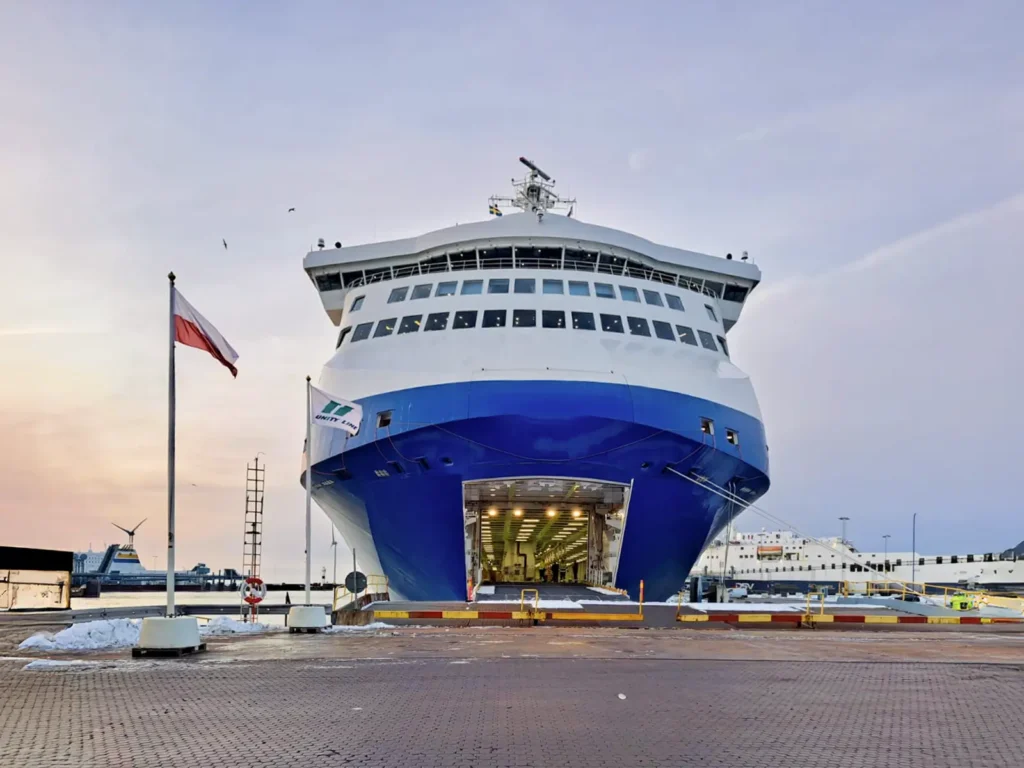
Typically, a booking number, registration number, and a declaration for dangerous goods (ADR), if applicable, are required. A TIN may be required to enter the terminal for dropping off or picking up a trailer. When collecting a trailer from the Unity Line ferry in Świnoujście, a written authorization for the driver to collect it is required. Additionally, the Ferry Terminal in Świnoujście requires a completed trailer condition report (form “Trailer report”) when dropping off a trailer for the ferry.
In terms of time spent at sea – yes. The voyage from Świnoujście to Ystad or Trelleborg takes approx. 6-7 hours, from Świnoujście to Malmö approx. 8-9 hours, whereas the crossing from Gdynia to Karlskrona takes approx. 10-12 hours, and from Gdańsk to Nynäshamn 18 hours. However, when choosing a route, the total travel time must be considered, including access via the A2/S3 motorway to Świnoujście or the A1 motorway to Tricity.
Yes, all three ports handle ADR dangerous goods, but capabilities depend on the specific vessel type (passenger-car ferries have more restrictions than dedicated Ro-Ro cargo vessels). Transport of dangerous goods always requires prior notification and may involve an additional fee and the necessity to choose a specific voyage.
FREIGHT FORWARDER'S CHECKLIST
Direction: Optimization for empty runs.
Tachograph: Driver rest period planning (9/11h).
Cargo: Reefer power supply and ADR declarations.
Dimensions: Vehicle dimensions vs. oversize booking.
Costs: Verification of ETS and fuel fees.
Data: Correctness of registration numbers and TIN.