


One Abbreviation That Changes Everything
The choice of Incoterms rules is often made “out of habit,” without a real risk analysis.
Meanwhile, a single incorrect abbreviation in a contract can mean that you – not your counterparty – will pay for damaged goods at the port.
What exactly are Incoterms and why is the 2020 version crucial?
The Incoterms rules (International Commercial Terms) are the foundation of international trade. While at first glance they may seem like mere technical abbreviations, in reality, they constitute a precise business language that helps avoid costly misunderstandings.
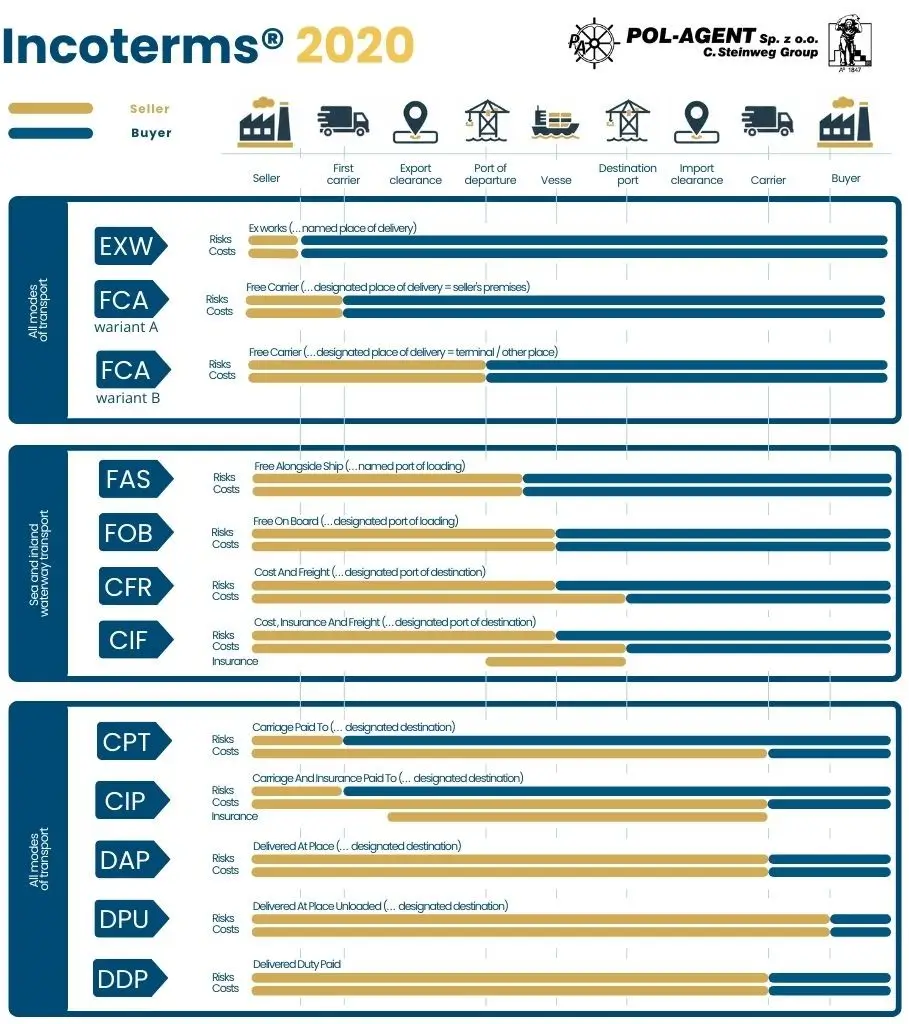
Allocation of Responsibilities: Costs and Risk
The most important function of Incoterms is to clearly define two critical points in the delivery process:
- Cost Transfer Point: Specifies the location up to which the seller is responsible for transport, customs duties, and insurance, and from which point the buyer assumes these expenses.
- Risk Transfer Point: Designates the specific point at which liability for potential damage or loss of goods shifts from the seller to the buyer.
Important Disclaimer: It is crucial to remember that these rules do not determine the transfer of title to the goods. This matter should always be regulated separately in the commercial contract, as Incoterms focus exclusively on physical delivery and associated financial expenditures.
Currently, the latest applicable version is Incoterms 2020, which introduced significant changes (e.g., replacing the DAT rule with the DPU rule or clarifying insurance under CIP). However, it is important to note that:
- Older versions remain valid: Incoterms are not a top-down imposed law; they are a set of voluntary rules. This means that if both parties agree, they may still use the 2010 or even 2000 versions.
- Requirement for Precision: To avoid legal disputes, every abbreviation on an invoice or in a contract (e.g., FOB, CIF, or DDP) must include a reference to the specific version.
- Recommended Format: The correct entry should appear as follows:
[Chosen Abbreviation] [Exact Place of Delivery] Incoterms 2020
The absence of a version specification can lead to a situation where the seller and buyer interpret a given abbreviation according to different editions of the rules, which, in the event of a ship breakdown or port delays, becomes the root cause of a serious financial conflict.
Most Common Errors When Choosing Incoterms
Using EXW in exports
EXW (Ex Works) seems the simplest, but it leaves all export risk with the buyer,
which complicates customs formalities.
Confusing FOB with FCA
FOB applies only to sea transport. For containers, FCA is a better choice,
as it more precisely defines the moment of risk transfer.
Lack of precise delivery location specification
The abbreviation alone is insufficient – a specific location must always be added, e.g., “CIF Gdynia, Poland”.
Best Practices for 2026
Analyze the total cost of delivery (TCO)
Do not focus solely on the price of the goods – consider transport, insurance, customs duties, and risk.
Match the rule to the mode of transport
FAS, FOB, CFR, CIF – exclusively for sea transport. For other modes: FCA, CPT, CIP, DAP, DPU, DDP.
Always consult with the logistics department
Sales and procurement departments should collaborate with logistics to select the optimal rule.
Most Commonly Used Incoterms Rules at Pol-Agent
| Rule | Application | What you need to know |
|---|---|---|
| FOB | Sea transport | Seller is responsible until goods are loaded onto the vessel |
| CIF | Sea transport | Seller pays for freight and minimum insurance |
| DAP | Road / multimodal | “Door-to-door” delivery, import customs clearance by the buyer |
Why Are These Rules Predominant?
- FOB [Free on Board]: Allows the buyer to retain control over sea freight costs and select their own freight forwarder, which is crucial for large volumes from Asia.
- CIF [Cost, Insurance and Freight]: Often selected by novice importers, as the seller undertakes the organization of main carriage and insurance.
- DAP [Delivered at Place]: Standard for road transport within Europe. It is highly convenient, as goods are delivered directly to the buyer’s warehouse, while maintaining a clear division of customs responsibilities.
Summary for Your Convenience:
Please remember that the choice of rule always depends on your trade experience and relationship with your counterparty. If you import goods from distant locations, FOB offers you the greatest flexibility in supply chain management. If simplicity is a priority for deliveries from the EU, DAP will be the most judicious choice.
How to Choose Wisely? (Expert Advice)
Control Your Transport – Choose F-Group Rules (FCA, FOB)
If you seek genuine influence over costs and delivery timeliness, the safest solution is to select rules from Group F.
- Decision-Making Authority: By selecting, for instance, FOB or FCA, you determine which freight forwarder (e.g., Pol-Agent) will manage your cargo.
- Cost Transparency: You avoid hidden port or handling fees that foreign suppliers often add to invoices under C-group rules (e.g., CIF).
- Information Security: By collaborating with your freight forwarder, you gain direct insight into the shipment status and actual transport time.
Remember Insurance – Standard Coverage Is Often Insufficient
Many companies operate under the misconception that goods are always fully protected. However, the reality of Incoterms presents a different picture:
- Insurance Obligation: Only the CIP and CIF rules impose a formal obligation on the seller to procure an insurance policy.
- Scope of Coverage: Under the CIF rule, the seller is only required to provide insurance with minimal coverage (known as Clause C), which may not cover many typical transport damages.
- Consider Cargo Insurance: Regardless of the chosen rule, we always recommend purchasing additional Cargo insurance. It provides comprehensive financial door-to-door protection, shielding you from the consequences of unforeseen events beyond the carrier’s control.
Do you have questions regarding your Incoterms rule?
We will analyze your contract and help you choose delivery terms,
that will truly protect your business.